

There is a moment that happens in almost every correction appointment, and it is usually quiet. It doesn’t come with drama or big reactions. It shows up in a sentence that sounds simple, logical, and completely reasonable on the surface.
“Can we just go over it with brown?”
That question carries one of the biggest misunderstandings in this entire industry. Not because people are careless. Not because they’ve made a mistake. But because no one has ever explained what is actually happening underneath the skin. The truth is this: color does not cover color. It never has. It never will. It blends together, one color simple merges with the other.
And that single misunderstanding is responsible for more long-term brow issues than almost anything else. It is the reason clients walk in feeling confused about why their brows have become heavier, darker, or less defined over time. It is also the reason correction exists as a specialized skill rather than a simple adjustment. If you want to understand what is actually happening during a correction process, this is explained in depth here: what actually happens during eyebrow correction step by step. Because once you understand this concept properly, everything else begins to make sense.
What Is Actually Sitting in the Skin
When pigment is placed into the skin, it does not sit on top like makeup. It becomes part of the skin’s structure, held within layers that heal, shift, and evolve over time. That pigment does not disappear simply because something new is added. It remains present, interacting with anything placed within it. This is where the misunderstanding begins. The assumption is that new pigment replaces old pigment. In reality, it mixes with it.
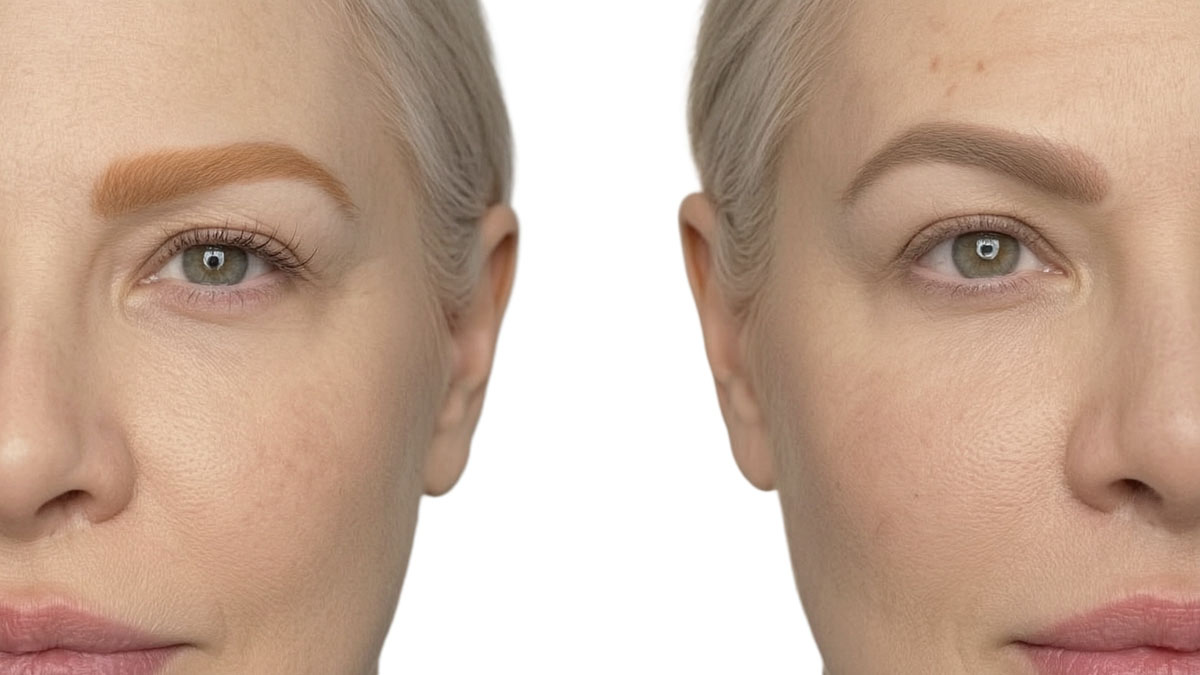
So, when someone has a cooler tone—like blue or grey—and brown is placed over it, the result is not a fresh, clean brown. It is a combination of both colors. And that combination creates something entirely different than what was intended. This is why clients often describe their brows as “off” rather than completely wrong. Because technically, something improved. But fundamentally, the underlying issue was never resolved. The behavior of pigment over time is something we also explore here: why your brows look different years later. Because the shift seen later is not random. It is the natural result of how those pigments have been layered and combined.
Why Brown Is Not the Solution Everyone Thinks It Is
There is something about brown pigment that feels safe. It feels neutral, reliable, corrective. It is often treated as the universal solution—something that can be placed over anything to bring it back to balance. But brown is not a single color. It is a composition on multiple colors. It contains red, yellow, and blue. And depending on what is already present in the skin, those underlying colors will react differently. When brown is placed over blue, the result leans cooler. When brown is placed over warmth, that warmth still remains. It does not neutralize it. This is why layering without understanding color science creates buildup rather than correction. Each additional pass introduces more complexity, not more clarity.
Over time, that complexity becomes visible. Brows begin to look more solid, more dense, less refined. Not because the work was poorly done in a single session, but because the process was repeated without adjusting the foundation. This is also why repeating the same technique over time changes results, which we break down here: why repeating the same technique changes results. Repetition without adjustment does not maintain a result. It alters it. Adding fresh brown pigment over older work isn’t always the safest or most predictable solution, which is why we begin with a complete eyebrow tattoo repair and redo assessment.
The Difference Between Layering and Correcting
There is a subtle but critical difference between adding and correcting. Adding is simple. It is direct. It feels efficient. Correction, on the other hand, requires pause, analysis, and restraint. Layering says, “Let’s improve this by adding more.” Correction asks, “What is already here, and what is missing?” Sometimes there are missing colors. If the brow is red, the missing colors are blue and yellow (green). That question changes everything. Because when you begin by identifying what is missing, you stop reacting to what you see and start understanding why it looks that way in the first place. And once that understanding is in place, the approach becomes intentional rather than reactive. This is why correction is considered a different level of work entirely: why eyebrow correction is a different skill not every artist can do it. It is not simply about creating a beautiful brow. It is about solving a problem that already exists—and doing so in a way that allows the result to evolve correctly over time. Many older tattoos first require correction of the existing pigment and shape before additional color can be considered.
Why the Skin Cannot Be Treated as One Surface
Another misconception that often leads to inconsistent results is the idea that the brow can be treated as one uniform area. In reality, most brows that require correction contain multiple conditions within the same shape. One section may be cooler. Another may hold warmth. Another may be more saturated or sit deeper in the skin. Treating all of these areas the same creates imbalance, even if the overall shape appears consistent from a distance. True correction isolates the problem rather than generalizing it. It recognizes that different areas require different approaches, and it responds accordingly. This level of precision is what allows the brow to come back into balance without becoming heavier or more complicated in the process. And when this is done properly, the brow begins to feel cohesive again—not layered, not conflicting, not visually divided into sections that behave differently.
The Role of Restraint in Real Correction
One of the least talked about aspects of correction is restraint. There is a natural instinct to do more—to add more pigment, to intensify the result, to push toward immediate improvement. But correction does not reward that instinct. It rewards control. Because every time pigment is placed into the skin, it becomes part of the long-term outcome. It is not temporary. It is not easily reversed. And that means every decision matters more. This is why experienced correction work often looks slower from the outside. There is less rushing, less covering, less immediate transformation. But what is happening underneath is far more precise. Each pass, each placement, each adjustment is done with the understanding that the result will continue to evolve long after the appointment ends. And that understanding is what protects the brow from becoming overworked.
When Color Is Understood, Everything Changes
There is a moment in correction where everything begins to shift. It is not dramatic, and it is not instant, but it is noticeable. The color starts to soften. The tone begins to balance. The brow feels less resistant. This is the point where the underlying issue has been addressed, and the work begins to move forward rather than pushing against what was already there. From that point, shaping becomes easier. Blending becomes more natural. The entire brow begins to behave as one unified structure rather than multiple layers competing for attention. This is also why microblading alone is not always the long-term solution in correction cases. Because without correcting the base, no technique—no matter how well executed—can fully stabilize the result. Some clients are surprised to learn that their existing eyebrow tattoo may already be repairable.
The Real Takeaway
If there is one concept to carry forward from this, it is this: correction is not about adding more of the same brown. It is about understanding what is already there and responding to it with precision. Color does not cover color. It blends. And once you begin to see that clearly, you also begin to understand why so many brows become heavier over time—and how that process can be redirected. Because the difference between a brow that improves and a brow that becomes more complicated is not luck. It is not timing. It is not even the number of sessions. It is understanding. And that understanding is what allows correction to move from guesswork into something far more controlled, far more intentional, and far more successful long-term. If the brows have accumulated years of pigment, multiple layers of previous microblading may significantly influence the treatment strategy.
When to Consider Correction
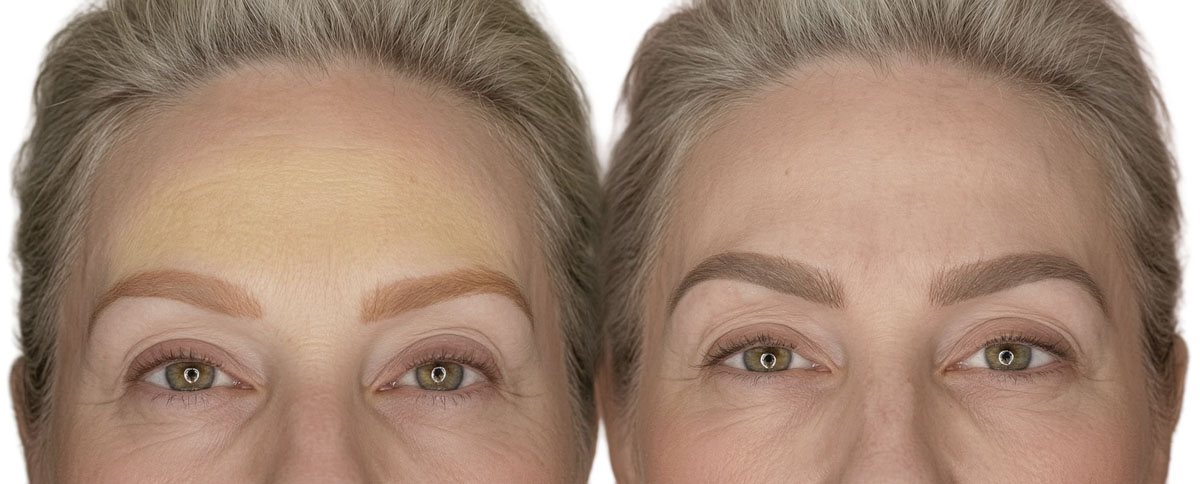
If your brows feel off in tone, uneven in color, or inconsistent over time, it may not be about adding more pigment. It may be about correcting what already exists. Understanding what a correction involves is the first step.
Ready for a more precise approach to color correction?
Schedule your appointment and experience results built on strategy, not layering.