MICROBLADING CORRECTION • DALLAS • FORT WORTH • TX
REAL RESULTS, INDUSTRY LEADER
If your once beautiful microblading now looks blurry, faded, patchy, uneven, gray, too dark, too thick, too close together, too far apart, or simply doesn’t feel like you anymore, you’re not alone.
Every year, thousands of people search for microblading correction because their eyebrows have changed over time or because they were never happy with the original result. Some clients loved their brows during the first few months, only to watch the strokes soften and lose definition over the following years. Others knew immediately that something wasn’t quite right and have spent months—or even years—wondering whether their eyebrows can be improved.
The answer is that many previous microblading procedures can be improved. The first step is understanding what your eyebrows look like today rather than focusing on what they looked like immediately after your original appointment.
This page is dedicated entirely to correcting previous microblading. It is not written for someone considering their first cosmetic eyebrow tattoo. Instead, it has been created for people who already have healed microblading and want to understand why their brows changed, what may be possible, and how different correction strategies are planned.
Microblading correction is one category within our complete Eyebrow Tattoo Correction library. Throughout this guide you’ll also find helpful resources covering eyebrow color correction, eyebrow tattoo repair, and corrections, redos and refreshes whenever those topics naturally relate to previous microblading.
If you’re ready to have your eyebrows evaluated, you can Book an Appointment. If you’d like additional information first, please Contact Us.
What Is Microblading Correction?
Microblading correction is the process of improving previous microblading that has already healed and changed over time. Unlike a first-time eyebrow procedure, correction begins with existing pigment already sitting inside the skin. That existing pigment influences every decision moving forward.
Some clients need faded hairstrokes rebuilt. Others have strokes that have blurred together. Some have brows that healed unevenly. Others have eyebrows that simply no longer complement their face the way they once did.
Rather than beginning with blank skin, correction begins with understanding the eyebrow that already exists. Existing pigment, healed stroke patterns, brow symmetry, facial proportions, natural eyebrow hair, skin quality, and the client’s long-term goals all influence the correction strategy.
That is why microblading correction should never be approached as simply “adding more strokes.” Every correction appointment begins with evaluation before any treatment recommendations are made.
If you’re unsure whether your eyebrows qualify as correction, we recommend first reading What Is a Correction? which explains how correction differs from first-time cosmetic eyebrow tattooing.
blurry
Correction
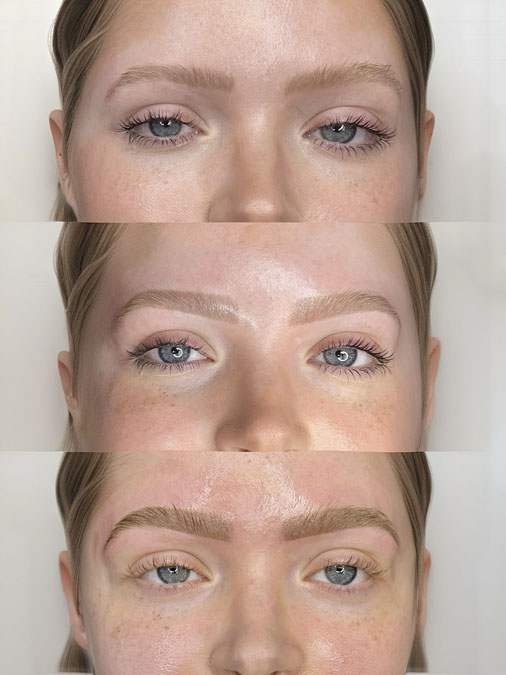
This client is a 29-year-old female with Fitzpatrick Skin Type I who had previous microblading completed approximately three years earlier. Her primary concern wasn’t fading—it was that the hairstrokes no longer looked like individual hairs. Instead, they appeared soft and blurry, making the brows feel heavier and less natural than when they were first completed. She described the brows as microblading gone wrong, although the original work had simply changed over time.
Before recommending treatment we evaluated the healed pigment, remaining hairstrokes, brow density, natural eyebrow hair, facial balance and previous microblading history. Every microblading correction begins by understanding why the brows currently look the way they do. Cases involving blurry microblading, failed microblading, and bad microblading often require a different correction strategy than patchy or faded brows. This example demonstrates why corrective microblading, microblading revision, and occasionally a microblading redo should always be planned after evaluating the complete eyebrow rather than focusing only on the blurred hairstrokes.
microblading
Powder
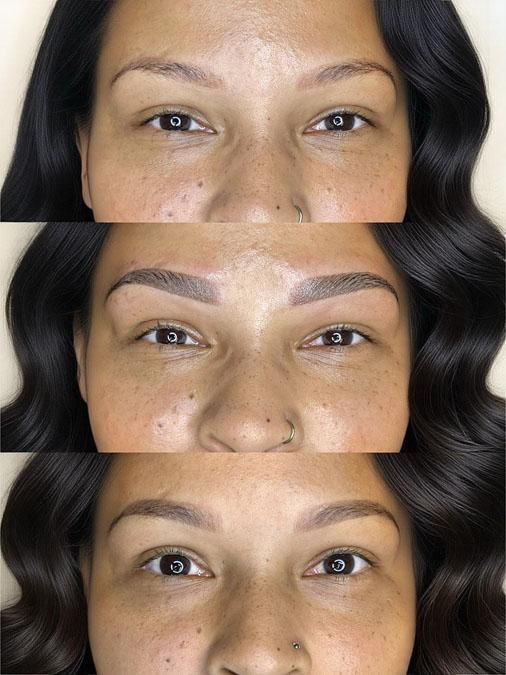
This client is a 32-year-old female with Fitzpatrick Skin Type IV who had previous microblading completed approximately four years earlier. While she still appreciated the general eyebrow shape, she felt the brows no longer framed her face with the same definition they once had. The hairstrokes had naturally softened and she had begun relying on eyebrow makeup again, prompting her to research a microblading redo to a powder brow.
During evaluation we assessed the healed pigment, remaining hairstrokes, previous procedure history, natural eyebrow hair and the overall eyebrow design before determining the most appropriate treatment plan. Every microblading redo begins with understanding the current eyebrow rather than automatically assuming another procedure is necessary. Cases like this often overlap with old microblading correction, faded microblading, microblading refresh, and microblading revision, making professional evaluation an essential part of successful microblading correction. This example demonstrates why clients throughout Dallas seek experienced guidance before deciding whether to redo microblading or pursue another correction pathway.
overworked
Correction
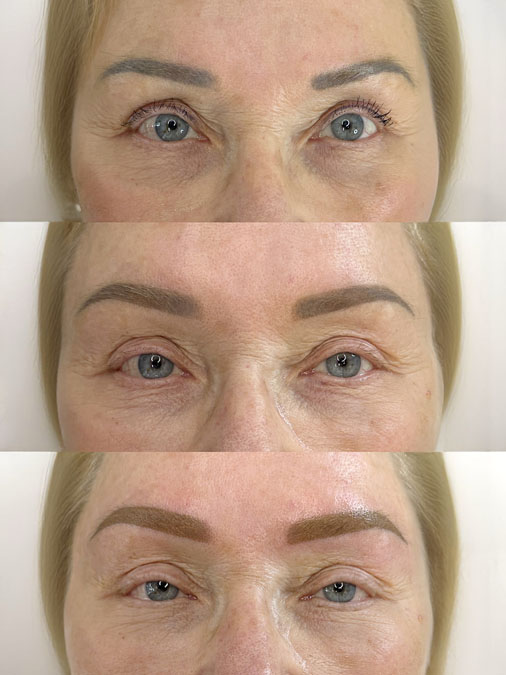
This client is a 65-year-old female with Fitzpatrick Skin Type II who had undergone four previous microblading appointments over six years. Each appointment added additional hairstrokes in an effort to improve retention, eventually leaving the brows looking dense, overworked and less natural than she wanted. She began searching online to fix botched microblading because she felt every additional appointment had made the brows progressively heavier.
During evaluation we carefully assessed the healed pigment, existing hairstrokes, previous procedure history, natural eyebrow hair, facial proportions and the overall eyebrow design before recommending microblading correction. Cases involving overworked microblading, bad microblading, and failed microblading require careful planning because the existing brows already contain significant tattoo work. This example demonstrates why corrective microblading, microblading revision, or a microblading redo should never be based simply on adding more strokes. Instead, every correction begins by understanding the current eyebrow and determining the most appropriate long-term solution for clients seeking professional microblading correction in Dallas.
old
Correction
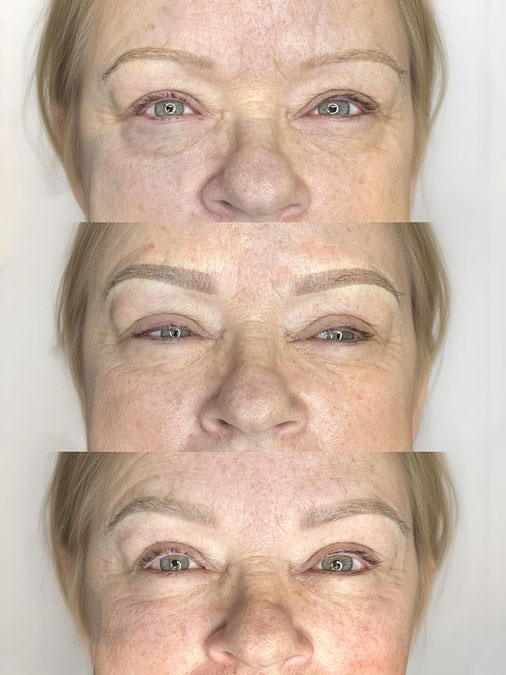
This client is a 67-year-old female with Fitzpatrick Skin Type I who had previous microblading completed approximately seven years earlier. Her primary concern was not the individual hairstrokes or the healed pigment—it was the overall eyebrow shape. She felt the existing brows no longer complemented her facial features and had begun searching online for microblading correction because she believed the previous shape no longer suited her.
Before planning treatment we evaluated the healed pigment, previous microblading history, facial proportions, natural eyebrow hair and overall eyebrow structure before determining the most appropriate correction strategy. Cases involving poor eyebrow shape often overlap with bad microblading, microblading gone wrong, failed microblading, and clients considering a microblading revision or microblading redo. This example demonstrates why corrective microblading focuses on improving the eyebrow as a complete design rather than simply adding new hairstrokes. Every treatment begins with understanding the current eyebrow before recommending the most appropriate long-term solution.
Who Is This Guide For?
This guide has been written specifically for people who already have previous microblading.
You may be in exactly the right place if you’ve searched for phrases such as:
- Microblading correction near me
- Fix bad microblading
- Corrective microblading
- Old microblading correction
- Blurry microblading
- Patchy microblading
- Uneven microblading
- Microblading gone wrong
- Failed microblading
- Faded microblading
- Microblading revision
- Microblading refresh
- Microblading repair
Many of our clients have spent months researching previous eyebrow tattooing before deciding to move forward. Some have covered their brows with makeup every day. Others avoid photographs because they no longer feel confident about the appearance of their eyebrows.
Whether your microblading is two years old or ten years old, understanding why your eyebrows changed is often the first step toward determining what type of improvement may be possible.
Why Microblading Correction Is Different From New Microblading
One of the biggest differences between first-time microblading and correction is that correction does not begin with untouched skin.
Instead, the artist must evaluate pigment that has already healed, already aged, and already influenced the skin.
That existing pigment affects:
- Colour selection
- Stroke placement
- Stroke direction
- Eyebrow mapping
- Overall density
- Possible shape adjustments
- Healing expectations
- Long-term treatment planning
Because of this, correction requires significantly more planning than simply performing another microblading procedure.
Every recommendation should begin with understanding what is already present rather than automatically placing additional hairstrokes throughout the eyebrow.
Our Philosophy on Microblading Correction
Our philosophy is simple.
- Respect the existing eyebrow.
- Understand the healed pigment.
- Create a realistic plan.
- Improve what already exists.
Correction is not about pretending the previous microblading never happened. It is about understanding exactly how that previous work has healed and using that information to create the most attractive long-term result possible. Sometimes that means rebuilding faded strokes. Sometimes it means refining the overall shape. Sometimes it means refreshing older brows. Sometimes it means recognising that another correction category may be more appropriate. For example, if your primary concern has become unwanted healed colour rather than the hairstrokes themselves, you’ll find much more detailed information inside our Eyebrow Color Correction guide.
Likewise, if previous microblading has created larger structural concerns involving eyebrow shape or placement, our Eyebrow Tattoo Repair hub explores those situations in greater depth.
Professional Insight
One of the biggest mistakes people make is assuming every faded microblading stroke needs another stroke placed directly on top of it.
In reality, beautiful correction usually comes from understanding the eyebrow as a complete design—not from replacing every individual hairstroke.
Why Does Microblading Change Over Time?
One of the most common questions we hear is, “My microblading looked amazing when it was first done. Why does it look so different now?” The answer is that every cosmetic eyebrow tattoo continues to evolve after it heals. Some changes are expected. Others are influenced by your skin, your lifestyle, the original technique, and the way your body has responded over the years.
Understanding why microblading changes over time is one of the most important parts of microblading correction because your brows today—not your brows on appointment day—determine the most appropriate correction strategy.
Every correction appointment begins by evaluating your healed eyebrows exactly as they are today. Existing pigment tells us far more than photographs taken immediately after your original procedure.
Microblading Is Designed to Change
Unlike traditional body tattoos, cosmetic eyebrow tattoos are designed to soften over time. As the skin naturally renews itself and the pigment ages within the upper layers of the skin, the appearance of the hairstrokes gradually evolves.
For many clients this softening is exactly what they expect. Others are surprised by how much their eyebrows have changed several years later.
Some eyebrows become lighter. Others lose definition. Some strokes remain beautifully separated, while others begin blending together. Every client heals differently, which is why no two correction appointments are ever identical.
Why No Two Clients Heal the Same
Even if two clients receive microblading on the same day using similar pigments and techniques, their eyebrows may look completely different several years later.
That is because healing is influenced by many different variables working together rather than one single factor. Some of the biggest influences include:
- Natural skin type.
- Oil production.
- Age.
- Sun exposure.
- Skincare products.
- Retinoids and exfoliating acids.
- Hormonal changes.
- Lifestyle.
- Smoking.
- Previous cosmetic tattoo history.
- Healing response.
- How many previous microblading appointments you’ve had.
Because of these differences, successful microblading correction is never based on assumptions. Every correction plan begins with understanding your individual eyebrows rather than comparing them to someone else’s healed results.
Why Microblading Strokes Become Blurry
Blurry microblading is one of the most common concerns we see. Clients often describe their eyebrows as looking softer, thicker, hazier, or less defined than when the strokes were first created. Several different factors may contribute to blurred hairstrokes over time.
- Natural skin aging.
- Very oily skin.
- Repeated microblading procedures.
- Closely spaced hairstrokes.
- Natural pigment diffusion over time.
- Changes within the skin itself.
Rather than assuming every blurry eyebrow requires additional hairstrokes, we first evaluate the overall stroke pattern, density, and healed appearance before recommending the most appropriate correction strategy.
Many clients searching for fix blurry microblading are actually better candidates for a more conservative approach than they initially expect.
Why Microblading Becomes Patchy
Patchy microblading occurs when different areas of the eyebrow retain pigment differently over time. One section of the brow may remain beautifully visible while another fades more quickly.
The fronts, arches, and tails often heal differently because each area experiences slightly different movement, oil production, skin characteristics, and environmental exposure.
Patchy healing does not automatically mean the original procedure was performed incorrectly.
Instead, it simply becomes part of the information we evaluate when creating a correction plan.
Brows that have simply faded naturally over several years may also fit within our Corrections, Redos & Refreshes category rather than requiring a more extensive repair.
Why Old Microblading Looks Different Than New Microblading
Fresh microblading and healed microblading are two completely different things.
When clients remember their original procedure, they often picture their brows during the first few weeks after treatment. However, those brows continue changing throughout the months and years that follow.
Older microblading generally appears softer, lighter, and less sharply defined than fresh microblading. This is completely normal and is one reason why evaluating healed eyebrows is far more valuable than evaluating fresh photographs.
When planning correction, we focus on today’s healed eyebrows because they provide the most accurate representation of the pigment currently sitting within the skin.
Why Healed Microblading Matters More Than Fresh Photos
Many clients bring photographs taken immediately after their original appointment. While these images help us understand the original design, they are not used to determine the correction plan.
Fresh cosmetic eyebrow tattoos often appear darker, sharper, warmer, and more saturated than they eventually heal.
Instead, correction focuses on what we can actually see today:
- The healed colour.
- The remaining stroke pattern.
- The existing density.
- The overall eyebrow shape.
- Natural eyebrow hair.
- Current facial proportions.
This allows us to build a treatment plan around reality rather than memory.
Why Existing Colour Still Matters
Although this guide focuses specifically on microblading correction, colour remains an important part of every evaluation.
Some previous microblading heals gray. Others develop warmer tones over time. Some brows become slightly ashy, while others retain beautiful neutral colour for many years.
When healed pigment becomes your primary concern rather than the hairstrokes themselves, we recommend continuing with our Eyebrow Color Correction Guide, which explores healed pigment behaviour in much greater detail.
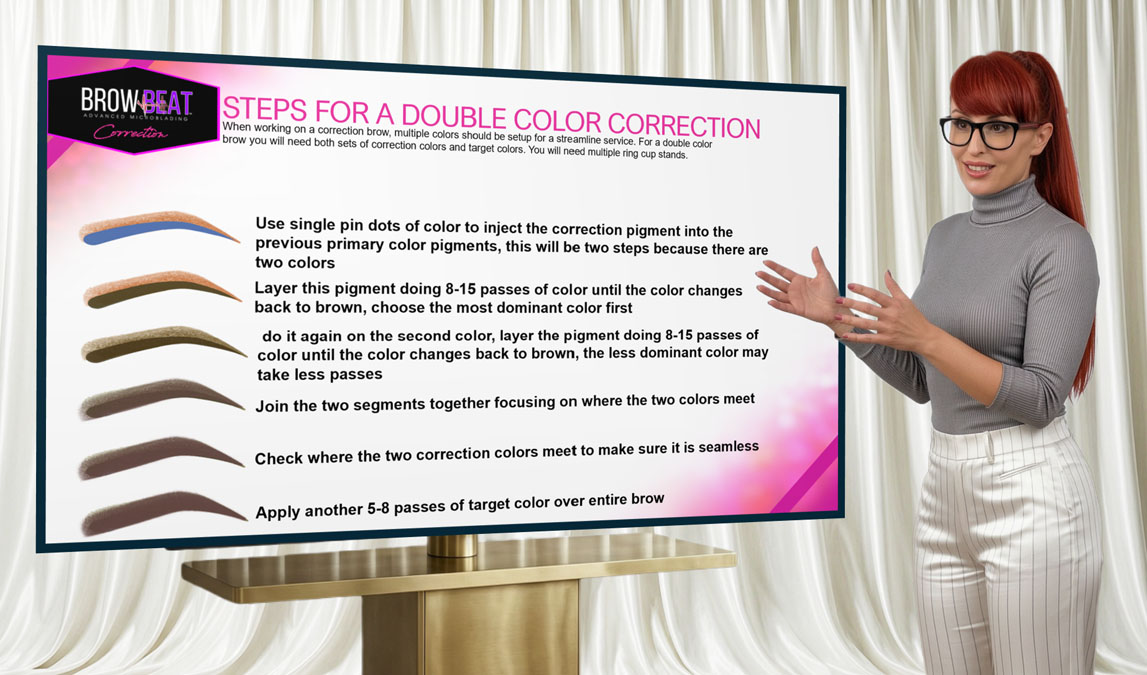
Microblading Correction Begins With Understanding — Not Guessing
Every successful correction starts with education.
Rather than assuming your eyebrows need more strokes, a completely new shape, or additional density, we begin by understanding exactly how your previous microblading has changed over time.
That careful evaluation helps determine whether your brows would benefit most from rebuilding faded hairstrokes, refreshing older microblading, correcting healed pigment, repairing previous eyebrow tattooing, or simply making conservative refinements that improve the overall appearance while respecting the existing work.
The Most Common Microblading Correction Problems
Although every set of eyebrows is unique, most microblading correction appointments fall into a handful of common categories. Understanding which category best describes your eyebrows can help you better understand why your brows look the way they do and which correction approach may be the most appropriate.
Many clients actually fall into more than one category. For example, you may have blurry microblading with uneven shape, or faded hairstrokes combined with unwanted healed color. Every treatment plan is customized to the eyebrows you have today rather than forcing every client into the same solution.
Blurry Microblading
Blurry microblading is one of the most common reasons clients begin searching for microblading correction. Instead of crisp individual hairstrokes, the eyebrows gradually begin looking softer, wider, or less defined than they once did.
Some people describe the appearance as hazy, smudged, or powdered. Others simply feel that the brows have lost the realistic hairstroke effect they originally loved.
Blurry microblading does not automatically mean your brows cannot be improved. Instead, we carefully evaluate the existing stroke pattern, overall density, healed pigment, and skin quality before determining the best correction strategy.
If your blurry microblading is also accompanied by unwanted gray, red, orange, or ashy pigment, you’ll also benefit from our Eyebrow Color Correction Guide.
Patchy Microblading
Patchy microblading occurs when different parts of the eyebrow retain pigment differently over time. One eyebrow may appear fuller than the other, the tails may have faded significantly, or isolated strokes may remain while surrounding strokes become difficult to see.
Patchiness is one of the reasons correction should always be customized. Simply rebuilding every faded area is not always the best long-term solution. Instead, we evaluate the overall eyebrow to determine whether selective refinement, rebuilding, or refreshing will create the most balanced healed appearance.
Older brows that have naturally softened may also fit within our Corrections, Redos & Refreshes hub.
Uneven Microblading
No human face is perfectly symmetrical. However, previous microblading can sometimes exaggerate natural asymmetry rather than complement it.
Uneven microblading may involve different arch heights, mismatched tails, uneven fronts, inconsistent stroke density, or brows that simply don’t appear to belong together.
Correction focuses on improving overall balance rather than making both eyebrows mathematically identical. Beautiful eyebrows work together as a pair while still respecting natural facial asymmetry.
Faded Microblading
Fading is a natural part of cosmetic eyebrow tattooing. Some clients notice gradual softening after twelve to eighteen months, while others enjoy visible strokes for several years before seeking a refresh.
The important question is not simply whether your microblading has faded, but how it has faded.
Even fading often creates a beautiful foundation for conservative correction. Uneven fading may require a different strategy. Every healed eyebrow tells a different story.
Microblading That Is Too Dark
Some clients feel their eyebrows appear darker than expected long after healing. This may be related to pigment saturation, previous appointments, healed color changes, or the overall eyebrow design.
Correction is not automatically about adding more pigment. In many situations, improving shape, density, or balance creates a softer appearance without dramatically changing the overall eyebrow.
When healed color is the primary concern, we recommend continuing with our Eyebrow Color Correction resource.
Microblading That Is Too Thick
Eyebrow trends change over time. Brows that once felt fashionable may later feel heavier or larger than the client prefers.
Thick microblading may involve oversized fronts, broad arches, heavy tails, or a brow shape that extends beyond the client’s natural facial proportions.
Correction planning focuses on understanding how the existing tattoo interacts with the face today before recommending any changes.
If the overall structure of the eyebrow presents larger design challenges, additional information can be found in our Eyebrow Tattoo Repair hub.
Microblading That Looks Artificial
Many clients simply tell us their eyebrows no longer look natural.
Sometimes the strokes have blurred together. Sometimes the spacing feels unnatural. Sometimes previous touch-up appointments have gradually increased density until individual hairstrokes are no longer visually distinct.
Rather than trying to recreate every original stroke, correction often focuses on improving the eyebrow as a complete design.
This philosophy allows the brows to appear softer, more balanced, and more harmonious with the client’s natural features.
Previous Microblading Performed by Multiple Artists
One situation we frequently see involves eyebrows that have been worked on by multiple artists over many years.
Each artist may have used different pigments, different mapping techniques, different stroke patterns, and different approaches to density. The result can be an eyebrow containing several generations of cosmetic tattooing.
These brows require especially careful planning because the correction strategy must consider every layer of existing work rather than focusing only on the most recent procedure.
Microblading Correction Is About Improving the Entire Eyebrow
One of the biggest differences between correction and first-time microblading is perspective.
Instead of concentrating on one individual stroke or one small section of the eyebrow, correction looks at the eyebrow as a complete composition.
The overall shape, healed color, density, balance, facial proportions, natural eyebrow hair, and long-term appearance all work together.
Beautiful correction is rarely created by solving one isolated problem. It is created by improving how every part of the eyebrow works together.
Professional Insight
Clients often focus on the single feature that bothers them most—perhaps a blurry tail or a faded front. As correction artists, we evaluate the entire eyebrow because small improvements across several areas usually create a more beautiful healed result than dramatically changing one section alone.
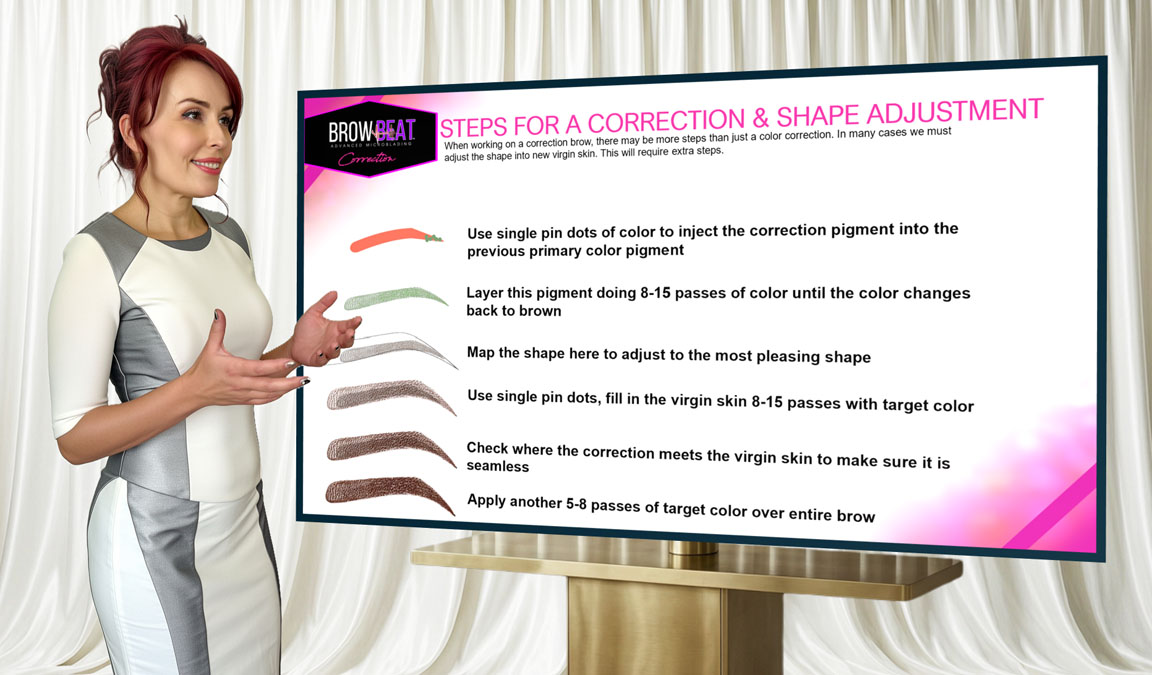
Who Is a Good Candidate for Microblading Correction?
Not every previous microblading procedure requires the same solution. Some eyebrows need only a conservative refresh, while others benefit from rebuilding faded hairstrokes, improving symmetry, correcting healed color, or repairing previous eyebrow tattooing.
A good candidate for microblading correction is someone who already has healed microblading and would like to improve the appearance of their existing brows rather than begin with untouched skin.
Many of our clients have lived with previous microblading for several years before deciding it is time to improve it. Others seek correction much sooner because they are unhappy with the original result. Every situation is different, which is why every treatment plan begins with evaluating your eyebrows as they look today.
You May Be a Good Candidate If…
- Your microblading has become blurry.
- Your hairstrokes have faded unevenly.
- Your brows appear patchy.
- Your eyebrows no longer feel balanced.
- Your previous microblading looks too heavy.
- Your brows have become difficult to shape with makeup.
- Your eyebrows no longer suit your face.
- Your healed pigment has changed over time.
- Your previous artist is no longer available.
- Your eyebrows simply no longer reflect the look you want today.
Every eyebrow tells a different story. During your appointment, we evaluate the existing pigment, healed stroke pattern, brow symmetry, natural eyebrow hair, skin quality, and your long-term goals before recommending the most appropriate correction strategy.
When Another Correction Category May Be More Appropriate
Although this page focuses specifically on previous microblading, not every client ultimately falls into the microblading correction category.
Some eyebrows require a different type of correction depending on the primary concern.
Our Approach to Microblading Correction
One thing you’ll notice throughout this website is that we use careful language when discussing correction. We intentionally avoid making unrealistic promises or suggesting that every eyebrow can be dramatically transformed in a single appointment.
Instead, our approach focuses on creating thoughtful improvements that respect the existing eyebrow, protect the skin, and produce attractive long-term healed results.
Sometimes that means rebuilding faded hairstrokes.
Sometimes it means improving symmetry.
Sometimes it means refining the overall design.
Sometimes it means recommending a conservative refresh rather than a complete reconstruction.
Every recommendation begins with understanding the eyebrow that already exists rather than trying to force every client into the same treatment.
Professional Insight
One of the biggest differences between an experienced correction artist and someone simply adding more microblading is restraint. Knowing what not to do is often just as important as knowing what can be improved.
Serving Clients Throughout Dallas & North Texas
Our microblading correction appointments welcome clients from throughout Dallas and the surrounding DFW Metroplex. Many of our clients travel from Highland Park, University Park, Preston Hollow, Lakewood, Uptown Dallas, Irving, Plano, Frisco, McKinney, Richardson, Garland, Arlington, Fort Worth, Southlake, Grapevine, Colleyville, Keller, Coppell, Flower Mound, and neighboring North Texas communities.
Because previous microblading affects your appearance every day, many clients are willing to travel for an artist who focuses specifically on correcting healed cosmetic eyebrow tattoos rather than only performing first-time procedures.
If you’re researching correction before making a decision, we also encourage you to browse our Before & After Gallery, continue learning through our
Microblading Correction Blog, or read our complete Eyebrow Tattoo Correction Guide, which explains how all four correction categories work together.

Whether your eyebrows have become blurry, faded, patchy, uneven, overly saturated, outdated, or simply no longer feel like you, the first step is understanding your options.
Our goal is to help you make informed decisions about your existing eyebrows by evaluating the healed microblading already present in your skin and recommending the correction strategy that best fits your individual brows.
If you’re ready to move forward, you can Book an Appointment.
If you’d like to ask questions before scheduling, please Contact Us.
Frequently Asked Questions About Microblading Correction
If you’re researching previous microblading, you’re probably comparing information from multiple sources. Below are answers to some of the questions we hear most often from clients throughout Dallas, Highland Park, University Park, Preston Hollow, Lakewood, Irving, Plano, Frisco, McKinney, Richardson, Garland, Arlington, Fort Worth, Southlake, Grapevine, Colleyville, Keller, Coppell, Flower Mound, and the surrounding DFW Metroplex.
Microblading correction is the process of improving previous microblading that has healed in a way you no longer like. Depending on your brows, correction may involve refining shape, rebuilding faded hairstrokes, improving balance, refreshing older work, or creating a more flattering eyebrow while working with the existing pigment already present in the skin.
Yes. Many clients seek correction several years after their original appointment. Older microblading often softens, fades, or loses definition over time. Depending on the condition of the brows, they may be refined, refreshed, or rebuilt with a customized correction plan.
Many cases of bad microblading can be improved. Every correction begins by evaluating the healed brows rather than relying on how they looked immediately after the original procedure. Existing pigment, healed stroke patterns, brow shape, skin quality, and your long-term goals all influence the treatment plan.
Microblading can become blurry for several reasons, including skin type, natural aging, repeated procedures, closely spaced strokes, and how the pigment healed over time. Blurry strokes do not automatically mean your brows cannot be improved, but they should be evaluated individually before deciding on the next step.
Fading is a normal part of cosmetic eyebrow tattooing. The amount and pattern of fading varies from person to person. Evenly faded brows may simply benefit from a refresh, while uneven fading may require a different correction strategy.
Many uneven eyebrows can be improved by carefully evaluating the overall brow design, healed pigment, natural facial asymmetry, and existing stroke pattern. The goal is to create brows that appear balanced rather than perfectly identical.
Gray healed microblading is a common concern. If unwanted healed color is your primary concern, we recommend visiting our Eyebrow Color Correction guide for more detailed information.
Absolutely. Many clients simply have older brows that have faded naturally over time. These brows may benefit from a conservative refresh rather than a complete redesign. Learn more on our Corrections, Redos & Refreshes
page.
If your previous microblading involves significant shape concerns, oversized brows, misplaced pigment, or structural issues, your brows may fall into the eyebrow tattoo repair category rather than traditional microblading correction. You can learn more on our Eyebrow Tattoo Repair page.
Not necessarily. Every correction plan is individualized. The goal is to create the most balanced, natural-looking healed result possible rather than simply making the eyebrows darker or denser.
Yes. Many of our clients have previous microblading that is five, eight, or even ten years old. Older brows often require a different strategy than more recent work because the healed pigment and overall appearance have changed over time.
Previous work from multiple artists is very common. During evaluation we consider every layer of existing pigment, the different stroke patterns, healed colors, and overall brow design before recommending a correction plan.
Yes. Many clients aren’t sure whether they need microblading correction, eyebrow color correction, eyebrow tattoo repair, or a simple refresh. That’s completely normal. Your brows are evaluated first so the most appropriate correction strategy can be recommended.
We encourage every client to browse our Before & After Gallery to see a variety of healed correction cases involving different skin types, healed colors, stroke patterns, and previous microblading.
Our correction website contains a growing library of educational resources. You can continue learning through our Correction Blog, our What Is a Correction? guide, or our complete Eyebrow Tattoo Correction resource.
When you’re ready to move forward, you can Book an Appointment. If you have questions first, please Contact Us.