
One of the most common questions people ask before booking is simple: can old microblading be corrected without removal?
Usually, what they really mean is this:
Please don’t tell me I need laser.
And that reaction makes sense. Most people are not walking into a correction consultation hoping to hear that they need months of removal, healing, waiting, and then more work afterward. They want to know whether the brows they already have can be improved without taking them all the way backward first.
Most of the time, the answer is yes. A lot of old microblading can be corrected without removal.
But correction is never just a yes or no conversation.
It is always more like this:
Let’s look at what is actually sitting in your skin, and then I’ll tell you what is realistic.
That is the part people do not always love, because certainty feels better than nuance. People want to hear, “Yes, no problem, one session, done.” But that is not how this works, and anyone saying that too quickly is usually skipping the most important part: proper assessment.
If you are new to this process and want a clearer overview of how real brow correction works, you can learn more about eyebrow correction here.
Why Old Microblading Can Often Be Corrected
In theory, microblading is supposed to be shallow. It is supposed to sit higher in the skin, fade more softly, and hold a lighter, more delicate footprint over time than a traditional tattoo.
That is the theory.
Then there is real life.
And real life looks very different.
Some clients come in after one or two treatments and still have something soft, faded, and workable. Those are usually straightforward cases. Other clients have had their brows redone every year, sometimes more often, sometimes by multiple artists, and what they still call “microblading” is no longer really behaving like microblading at all.
At that point, we are not talking about airy little strokes anymore. We are talking about layered pigment that has accumulated in the skin over time.
I had a client sit down once and tell me she had had microblading around ten or maybe twelve times. I looked at her brows and they were solid, cool-toned, and heavily built up. There were no real strokes left. It was simply pigment. Then she said, “You can still see the strokes, right?”
And internally I thought, no, but I admire your optimism.
That is exactly what repeated layering does. Microblading done once is one thing. Done twice, still manageable. Done over and over again without a change in strategy, it eventually behaves more like a tattoo than a fresh stroke technique.
This is why the question is never just whether old microblading can be corrected. The real question is: what is it now?
Old Pigment Is Not Automatically a Disaster
One of the biggest mindset shifts in correction is understanding that old pigment is not the same thing as failed pigment.
A lot of people come in feeling embarrassed or upset because their brows have aged. They assume that because the color changed, or the strokes softened, or the shape feels heavier than it once did, something terrible must have happened.
Sometimes previous work was poor. That does happen.
But many times, what people are looking at is simply old pigment. And old pigment is inevitable. Every client eventually becomes an old pigment client. That is not a sign of disaster. It is just the natural outcome of semi-permanent makeup aging in real skin over time.
This is one of the reasons I often tell clients not to panic about color first. In many cases, color is not the main problem. It is often the easiest part of the correction conversation.
If your brows have shifted grey, warm, red, or orange, that does not automatically mean removal is needed. Tone can often be rebalanced. The more important questions are:
- How dark is the pigment?
- How dense is it?
- How large is the shape?
- How close are the brows to the center?
- How much flexibility is left in the design?
That is where real correction thinking starts.
If you want to understand why old brows can turn blue, grey, orange, red, or other unexpected tones, you can read more in this guide to faded brow color changes.
Why Removal Is Not Always the Best First Option
People sometimes talk about removal as if it is the obvious answer whenever there is old work. In reality, removal is not a magic reset button.
Removal takes time. It often means multiple sessions spaced weeks apart. It can be uncomfortable. In some cases, the brow area may need to be shaved or trimmed more than clients expect. And even after all of that, removal does not always completely erase the pigment. Most of the time, it lightens it.
That matters, because clients often go through months of removal only to still need correction later.
So when I assess a brow, I am not thinking, “Can I do something?” I am thinking, can I get this client to a genuinely strong result without putting them through removal first?
If the answer is yes, that is usually the better path.
Why? Because with correction, the brow is improving as we go. The client is moving forward. The shape is becoming more balanced, the color is becoming more controlled, and the brow is becoming more wearable each step of the way. That is a very different emotional and practical experience than spending months trying to erase something first.
The Real Limitations: Intensity, Size, and Placement
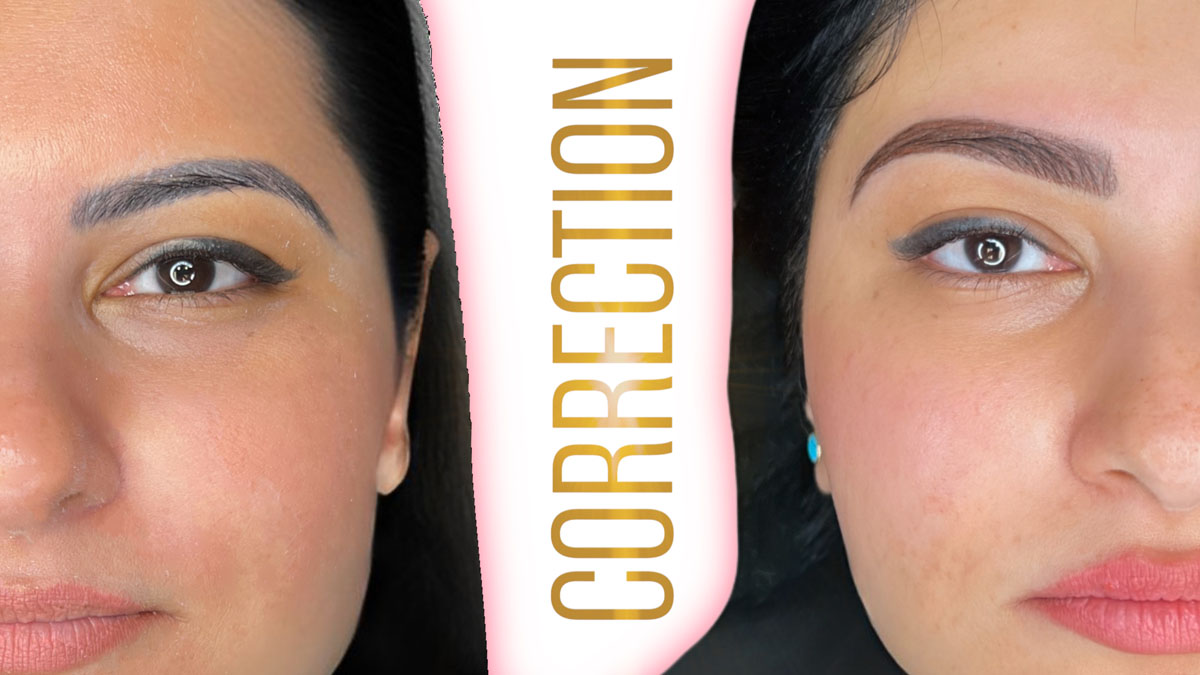
When people hear “correction,” they tend to focus on color. In reality, I am far more focused on intensity, size, and placement.
I can often work with old tone.
What gives me less freedom is when the pigment is:
- too dense
- too dark
- too wide
- too close together
- too compact at the front
Those are the cases where correction becomes more limited, not because improvement is impossible, but because there is less space to create softness and less room to modernize the structure.
One of my biggest rules is that the further apart the brows are, the more room I have to create a softer, more elegant front and a more controlled shape. When brows are very compact in the center and heavily saturated, the flexibility becomes smaller. That does not mean hopeless. It means strategy matters more.
And this is exactly why experience matters so much in brow correction. It is not just about applying pigment. It is about knowing where to leave things alone, where to build, where to soften, and when to tell a client that a certain aesthetic goal is no longer realistic without additional processes.
How I Assess Whether a Brow Can Be Corrected Without Removal
When someone asks if removal can be avoided, I am mentally assessing several things at once.
I am looking at how much pigment is actually still present. I am asking myself whether the brow feels like it is 30% faded, 50% faded, 70% still there, or almost solid. Once we get into higher density and higher saturation, the available softness in the final result becomes more limited.
I am also checking for uneven pressure history. This is especially common with older or repeated microblading. Microblading requires even pressure from start to finish, and when that is not there, the healed result can become inconsistent. Over time, instead of soft strokes, you get little blobs, darker deposits, heavier sections, and scattered patches of pigment.
That is not always “bad” in the dramatic sense people imagine. But it is inconsistent. And inconsistency matters.
Because correction means placing new pigment into existing pigment and creating a completely new healed outcome. The old work does not disappear just because we do not like it. It is still there. It will blend, influence, and affect everything new placed around or into it.
That is why old work can never simply be ignored.
Most People Are Not Actually Looking for Removal
This is something I think is worth saying out loud: most people are not walking in begging to remove everything. Usually, they are looking for a softer, fresher, more balanced version of what they already have.
They say things like:
- I just want them to look better again.
- I want them softer.
- I want to adjust the shape.
- I want them fresher, not harsher.
That tells me something important. In many of these situations, we are not dealing with disaster. We are dealing with pigment that has aged, layered, or shifted.
And that is exactly what correction is for.
Correction is not always about fixing something terrible. A lot of the time, it is about intelligently managing something that has been in the skin long enough to need a different kind of thinking.
If you want a deeper explanation of why proper correction thinking becomes necessary over time, this article on the hidden gaps in the microblading industry explains why repeated work often needs a specialist approach.
Why Correction Is Its Own Niche
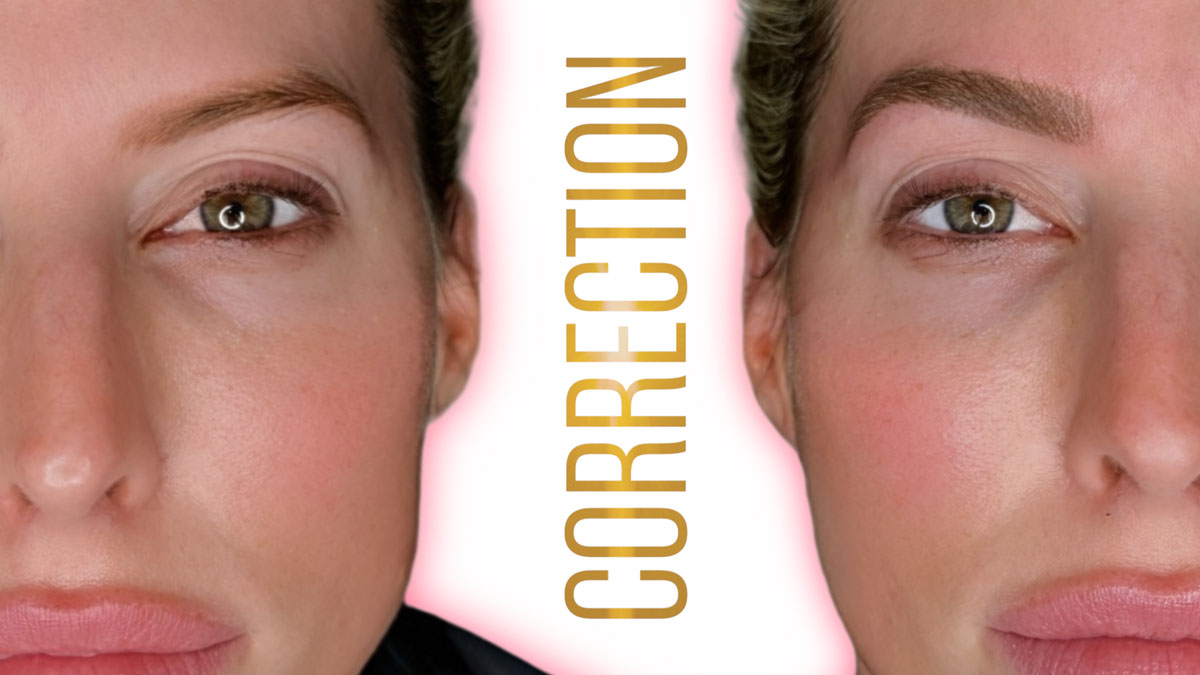
Many artists are used to working on fresh skin. Fresh skin gives clean starts and more predictable outcomes. Correction does not. Correction involves history, variables, and compromise.
That is why it is its own niche.
You are not simply “doing brows.” You are reading an existing situation and deciding how to work with it intelligently. You are deciding how to neutralize color, how to rebuild structure, how to preserve softness, and how to create a healed result that makes sense with what is already there.
That is a completely different way of thinking from simply creating a beautiful new set on clean skin.
How Many Sessions Does Correction Usually Take?
People want certainty here too, and I understand that. The easiest way to explain it is to compare correction to a new set of brows.
The first session builds the foundation.
The second session refines it.
Correction often follows that same pattern.
For many workable cases, two sessions is enough.
For heavier, denser, or more complicated cases, three sessions may be needed.
That is still often far more appealing than removal for most people, because you are moving toward a better result from the first appointment forward. You are not spending months going backward first.
This is why I often tell clients that good correction should feel like progress, not punishment.
When I Would Recommend Removal
There are absolutely cases where I recommend removal first. But it is not my default answer, and it is much rarer than many people think.
I start considering removal more seriously when the pigment is so dense, saturated, or compact that I cannot get the client to a result I would actually be proud of through correction alone.
Because again, this is not about whether I can do something. It is about whether I can get the client somewhere that actually looks good, feels balanced, and behaves well over time.
If I cannot get you there through correction alone, that is where removal becomes part of the conversation.
But that decision should come from experience and honest assessment, not from panic.
The Real Question Behind the Question
When someone asks, “Can old microblading be corrected without removal?” the deeper question is usually this:
Do I have another path besides starting all over?
And a lot of the time, yes, you do.
But what determines that is not hope alone. It is:
- the condition of the pigment
- the density
- the size
- the placement
- the history
- the skill of the artist evaluating it
That last part matters more than people realize.
You need someone who knows how to work with what is already there. Not someone who only knows how to place something new over the top and hope for the best.
Final Answer
So, can old microblading be corrected without removal?
Yes. In many cases, absolutely.
But only when:
- the pigment still allows it
- the structure still allows it
- and the artist understands how to work with existing pigment strategically
Because correction is not about covering something up.
It is about understanding what is already there and improving it with control, patience, and good decision-making.
If you are sitting there wondering whether you have to remove your brows, the better question is this:
Are you working with someone who actually understands how to correct old pigment?
Because that is what determines the result.
If you want to see how real brow correction cases are approached and what kinds of outcomes are possible, you can view real correction results here. And if you are ready to discuss what is realistic for your own brows, you can book an appointment here.